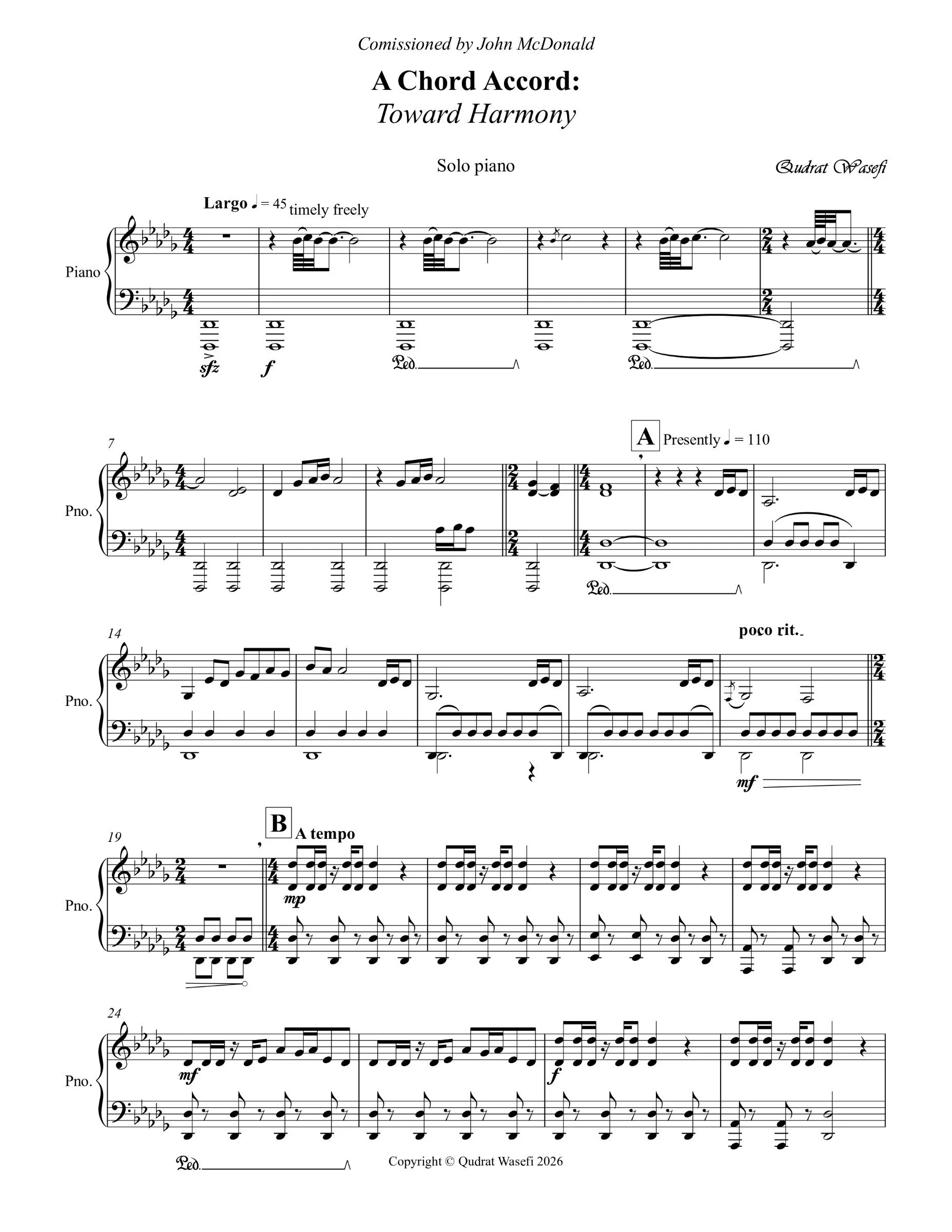
When John McDonald asked me to write something for him and explained his concept, “A Chord Accord,” he asked if I know what ‘accord’ meant. I answered honestly: no, I don’t.
For me, this piece reflects everything happening in the world, especially questions of diversity, color, harmony, beauty, and meaning. This work explores what a chord means to us. What is beauty in music? Is it defined by what, with respect to all composers, those from centuries past predominantly white men, sketched, designed, and passed down to us? Some of them did not even respect women or believe in the strength and artistry of female composers.
Bringing sounds and voices together in harmony is beautiful. Yet beauty is also subjective, an individual experience shaped by culture. What beauty means in one culture can differ entirely from another, because it depends on the elements that form that culture.
In this piece, I tried to move toward experimentation: exploring what chords mean to me personally, and how I relate to them culturally through sound design and resonance. I hope that through the power of sound we can find a path to come together in harmony, embracing one another despite differences in values, colors, and cultures.
I like to think of sounds and pitches as ingredients or spices used in cooking. Most species exist across the world, yet food tastes completely different depending on how they are used. Perhaps it is the process, the preparation, that makes the difference. In music, that process becomes the design of sound. One important thing not to forget is that music on paper is inactive until a human, in this case, John, gives it life and meaning. Otherwise, notes on a page remain silent symbols.
With that, I hope you feel a connection with this piece.
INSTRUMENTATION: Piano







Nastaran is an Afghan folk song. Most musicians believe that the nagham (melody) comes from Ustad Mohamad Omar, the most legendary rubab player of Afghanistan of all time. Nastaran is a very deep piece for me, one which goes inside the valleys of Afghanistan, and twists like wave or wind frequencies surrounding the high mountains and going village to village. The gentle minor and major modal melodies can be seen to depict the up and down aspects of living, which clearly describes the life of Afghan people. I have created an enhanced arrangement of Nastaran and included a choir with original lyrics. The most important meaning of this work to me is that in the past several months I have experienced things I never thought possible. Losing my country and being homeless created feelings of panic that will remain with me for the rest of my life. I have created this composition-arrangement of Nastaran to reflect what I have felt and experienced in these months. Seeing my people starving, no schools and work for girls and women, and watching the country go back a century…these were all not easy for me to believe and tolerate.
INSTRUMENTATION: SATB Choir, Flute, Oboe, Clarinet, Bassoon, Horn, Trumpet, Trombone, Snare Drum, Triangle, Bass Drum, Glockenspiel, Rubab, Tambor/Dutar, Violin, Viola, Cello, Bass